 EN
EN

In high-demand industrial environments, the performance of a vacuum system is rarely determined by the pump alone. The supporting components — the vacuum accessories that seal, connect, isolate, and protect every part of the system — are what separate a reliable process from a costly one. Engineers and procurement specialists who overlook these components often find themselves troubleshooting pressure instability, contamination events, and unplanned downtime that trace back not to the pump itself, but to a flange, fitting, or valve that failed under load.
Understanding which vacuum accessories contribute most to process reliability requires looking at the full system architecture — from the chamber interface to the pumping line — and evaluating each component's role in maintaining vacuum integrity under real operating conditions. This article examines the categories of vacuum accessories that deliver the greatest reliability impact, explains the engineering logic behind each, and provides practical guidance for selecting and integrating them into demanding industrial processes.
The Role of Vacuum Accessories in System Integrity
Why Accessories Define System Performance
A vacuum system is only as reliable as its weakest interface. While the pump generates the pressure differential, it is the network of vacuum accessories surrounding it that determines whether that differential can be maintained consistently over time. Flanges, gaskets, valves, traps, and fittings all contribute to the system's ability to hold vacuum, resist contamination, and survive thermal and mechanical cycling.
In industrial processes such as semiconductor fabrication, thin-film deposition, freeze-drying, and electron beam welding, even minor vacuum degradation can compromise product quality or trigger safety shutdowns. The vacuum accessories used in these environments must therefore meet stringent standards for leak tightness, material compatibility, and dimensional precision. Selecting the right accessories is not a secondary concern — it is a primary engineering decision.
Process engineers who treat vacuum accessories as commodity items often discover that inconsistent sourcing leads to variable sealing performance, accelerated wear, and increased maintenance intervals. A systematic approach to accessory selection, based on process requirements rather than cost alone, is the foundation of long-term reliability.
The Cost of Accessory Failure in Industrial Contexts
When vacuum accessories fail, the consequences extend well beyond the component itself. A single leaking flange can allow atmospheric gases to enter a process chamber, contaminating a batch that may represent hours of production time and significant material cost. In cleanroom environments, contamination events can trigger full chamber venting and requalification procedures that take days to complete.
Mechanical failures in vacuum accessories — such as a cracked fitting or a deformed gasket seat — can also create sudden pressure events that damage sensitive instrumentation or force emergency shutdowns. The cumulative cost of these events, including lost production, maintenance labor, and component replacement, typically far exceeds the cost of specifying higher-quality vacuum accessories from the outset.
This economic reality is why reliability-focused facilities invest in understanding the performance characteristics of each category of vacuum accessories rather than treating them as interchangeable. The right component in the right location delivers measurable returns in uptime and process consistency.
Sealing Components and Flanges
Blank Flanges as Reliability Anchors
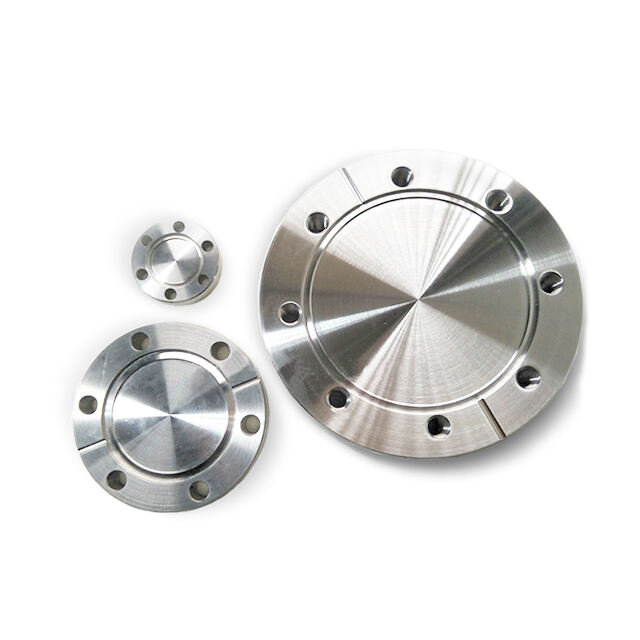
Among all vacuum accessories, sealing components occupy the most critical position in the reliability hierarchy. Every port that is not actively in use represents a potential leak path, and the way those ports are closed determines the baseline integrity of the entire system. Blank flanges — also called blanking flanges or closure flanges — are the primary solution for sealing unused ports on vacuum chambers and manifolds.
CF-style blank flanges, in particular, are widely used in ultra-high vacuum applications because of their knife-edge sealing geometry, which bites into a soft metal gasket to create a leak-tight seal capable of maintaining pressures below 10⁻¹⁰ mbar. The non-rotatable variant of this design is especially valued in fixed-port configurations where alignment is predetermined and rotational adjustment is unnecessary. These vacuum accessories provide a permanent, reliable closure that does not degrade under repeated thermal cycling.
The material selection for blank flanges matters significantly. Stainless steel grades with low outgassing characteristics are preferred for high-vacuum and ultra-high vacuum environments, as they minimize the introduction of contaminants into the process space. When vacuum accessories like blank flanges are specified correctly, they contribute directly to the system's ability to reach and maintain target pressure levels without extended pump-down times.
Gaskets and Sealing Materials
The gasket is the consumable element within the sealing assembly, and its selection has a direct bearing on process reliability. In CF flange systems, copper gaskets are standard for ultra-high vacuum applications because copper deforms predictably under the knife-edge compression load, creating a metal-to-metal seal with extremely low leak rates. For less demanding applications, elastomeric gaskets made from Viton or EPDM are used in KF and ISO flange systems.
Choosing the wrong gasket material for a given process is a common source of reliability problems. Elastomeric gaskets exposed to aggressive process chemistries or elevated temperatures can swell, crack, or outgas, introducing contamination and degrading the seal over time. Vacuum accessories that include properly matched gasket materials eliminate this failure mode and extend maintenance intervals significantly.
Regular inspection and scheduled replacement of gaskets, even in the absence of visible failure, is a best practice in high-reliability vacuum operations. The cost of a gasket is negligible compared to the cost of a contamination event or an unplanned shutdown caused by a seal that was allowed to degrade past its service life.
Valves and Flow Control Accessories
Isolation Valves and Their Reliability Impact
Isolation valves are among the most functionally important vacuum accessories in any industrial vacuum system. They allow sections of the system to be isolated for maintenance, venting, or reconfiguration without disturbing the rest of the process environment. In multi-chamber systems, isolation valves enable sequential processing and protect sensitive chambers from pressure excursions in adjacent sections.
Gate valves, angle valves, and butterfly valves each serve different roles within the vacuum system architecture. Gate valves provide full-bore isolation with minimal flow restriction and are preferred for high-conductance applications. Angle valves offer compact geometry suitable for roughing line connections. The selection of the appropriate valve type as part of the broader set of vacuum accessories directly affects both the system's pumping efficiency and its ability to respond to process upsets without cascading failures.
Valve actuation method also influences reliability. Manually operated valves are simple and robust but require operator intervention. Pneumatically or electrically actuated valves can be integrated into automated control systems, enabling faster response to process deviations and reducing the risk of human error. In high-throughput industrial environments, automated vacuum accessories of this type are a significant contributor to overall process reliability.
Throttle Valves and Pressure Regulation
Maintaining precise pressure control within a vacuum process chamber is essential for process repeatability. Throttle valves, also known as variable conductance valves, are vacuum accessories that regulate the pumping speed seen by the chamber, allowing the system to hold a target pressure setpoint even as gas loads vary during the process cycle.
In processes such as chemical vapor deposition or plasma etching, where gas flow rates change dynamically, throttle valves work in conjunction with pressure controllers to maintain stable conditions. Without this level of control, process parameters drift, leading to inconsistent results and increased rejection rates. The integration of throttle valves into the vacuum accessories specification is therefore a direct investment in process reliability and product quality.
The mechanical design of throttle valves must accommodate the corrosive and particulate-laden environments common in industrial vacuum processes. Materials selection, surface treatments, and seal design all contribute to the service life of these vacuum accessories under demanding conditions.
Traps, Filters, and Contamination Control Accessories
Cold Traps and Foreline Traps
Contamination control is one of the most underappreciated dimensions of vacuum system reliability, and the vacuum accessories designed for this purpose — traps and filters — play a critical role in protecting both the process and the pump. Cold traps use cryogenic surfaces to condense and capture vapors before they reach the pump, preventing oil backstreaming and protecting sensitive process environments from hydrocarbon contamination.
Foreline traps, positioned between the process chamber and the backing pump, capture oil mist and particulates that would otherwise migrate upstream into the process space. In applications where contamination of the process environment is unacceptable — such as optical coating, medical device manufacturing, or semiconductor processing — these vacuum accessories are not optional. They are fundamental to achieving the cleanliness levels that the process requires.
The maintenance schedule for traps is an important reliability consideration. A saturated cold trap or a clogged foreline trap reduces pumping efficiency and can become a source of contamination rather than a barrier against it. Facilities that track trap condition as part of their preventive maintenance program for vacuum accessories consistently report better process stability and longer pump service intervals.
Particulate Filters and In-Line Strainers
In processes that generate particulates — such as powder handling, sintering, or certain chemical reactions — in-line filters and strainers are essential vacuum accessories for protecting downstream components. Particulates that reach the pump can cause accelerated wear, valve damage, and seal failure, all of which translate directly into reduced system reliability and increased maintenance costs.
Filter selection for vacuum service requires attention to several factors: the particle size distribution of the contaminant, the flow conductance of the filter element, the compatibility of filter materials with process chemistries, and the ease of element replacement during scheduled maintenance. Vacuum accessories that are difficult to service tend to be serviced less frequently, which defeats their protective purpose.
Designing filter access into the system layout from the beginning — rather than retrofitting it later — is a hallmark of reliability-focused vacuum system engineering. When vacuum accessories like filters are integrated thoughtfully into the system architecture, they protect the entire downstream infrastructure and extend the intervals between major maintenance events.
Fittings, Connectors, and Structural Accessories
Flexible Bellows and Vibration Isolation
Mechanical vibration transmitted through rigid piping connections is a subtle but significant source of vacuum system degradation. Pumps generate vibration during operation, and without isolation, this vibration propagates through the vacuum accessories and piping network, stressing flange connections, fatiguing welds, and potentially damaging sensitive instrumentation or process equipment.
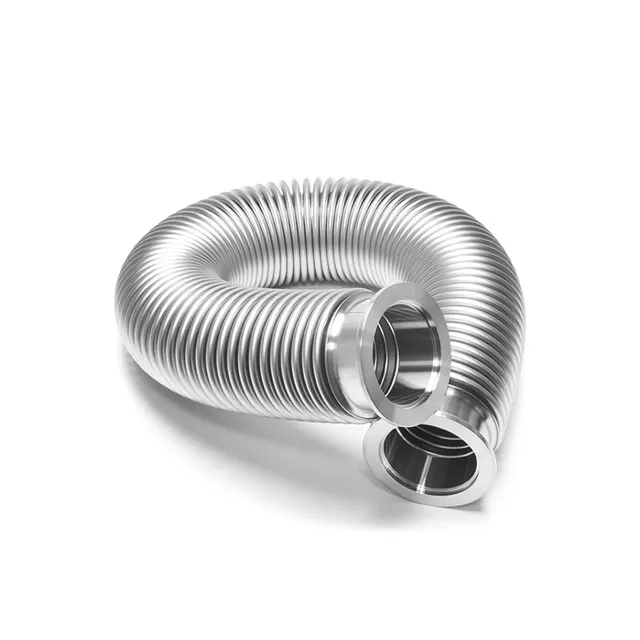
Flexible bellows connectors are vacuum accessories specifically designed to absorb vibration and accommodate thermal expansion and minor misalignment between system components. Constructed from corrugated stainless steel, they maintain vacuum integrity while providing the mechanical flexibility needed to protect rigid connections from fatigue failure. In systems where pumps operate continuously, bellows connectors are a straightforward reliability investment with a long service life.
The installation of bellows connectors also simplifies pump replacement and maintenance by allowing slight positional adjustment without requiring the entire piping network to be realigned. This practical benefit reduces the time and labor associated with maintenance events, contributing to overall system availability.
Tees, Crosses, and Manifold Fittings
The geometry of the vacuum piping network — how chambers, pumps, gauges, and valves are interconnected — is defined by the fittings and manifold components used. These vacuum accessories determine the conductance of the pumping path, the accessibility of individual components for maintenance, and the flexibility of the system for future reconfiguration.
Tee and cross fittings allow multiple connections to be made at a single point, enabling gauge ports, vent valves, and process gas inlets to be integrated into the pumping line without requiring custom fabrication. When these vacuum accessories are selected with attention to conductance and compatibility with the flange standard used throughout the system, they contribute to a coherent, maintainable architecture rather than a patchwork of adapters and workarounds.
Standardization of flange types and sizes across the vacuum accessories inventory is a practical reliability strategy. Systems built around a single flange standard — such as CF, KF, or ISO — are easier to maintain, easier to reconfigure, and less prone to the compatibility errors that arise when multiple standards are mixed without careful attention to sealing requirements.
FAQ
What makes vacuum accessories critical to industrial process reliability?
Vacuum accessories define the integrity of every interface in the system. Flanges, valves, traps, and fittings collectively determine whether the system can maintain target pressure, resist contamination, and survive the mechanical and thermal stresses of continuous industrial operation. A failure in any of these components can compromise the entire process, making accessory selection as important as pump selection.
How do blank flanges contribute to vacuum system performance?
Blank flanges seal unused ports on vacuum chambers and manifolds, eliminating potential leak paths that would otherwise degrade system pressure. CF-style blank flanges with knife-edge sealing geometry are particularly effective in ultra-high vacuum applications, providing reliable closure that maintains integrity through repeated thermal cycling and long-term operation.
Which vacuum accessories should be prioritized for contamination control?
Cold traps, foreline traps, and in-line particulate filters are the primary vacuum accessories for contamination control. Cold traps prevent oil backstreaming and vapor migration, foreline traps capture pump oil mist, and particulate filters protect downstream components from process-generated debris. All three categories should be included in the preventive maintenance schedule to ensure they continue to function as barriers rather than becoming contamination sources themselves.
How does standardizing vacuum accessories across a facility improve reliability?
Standardizing on a single flange type and a consistent set of vacuum accessories reduces the risk of compatibility errors during maintenance and reconfiguration. It simplifies spare parts inventory, shortens maintenance time, and ensures that technicians are working with familiar components. Over time, standardization also enables better data collection on component service life, supporting more accurate predictive maintenance programs.